Why Every Organization Needs a Professional Website — Even If You Have Facebook
Facebook and social media are powerful for reaching people, but they should not replace your official website. Learn why businesses, schools, institutes and organizations need a professional website for credibility, Google visibility, enquiries, applications, recruitment and long-term digital growth.
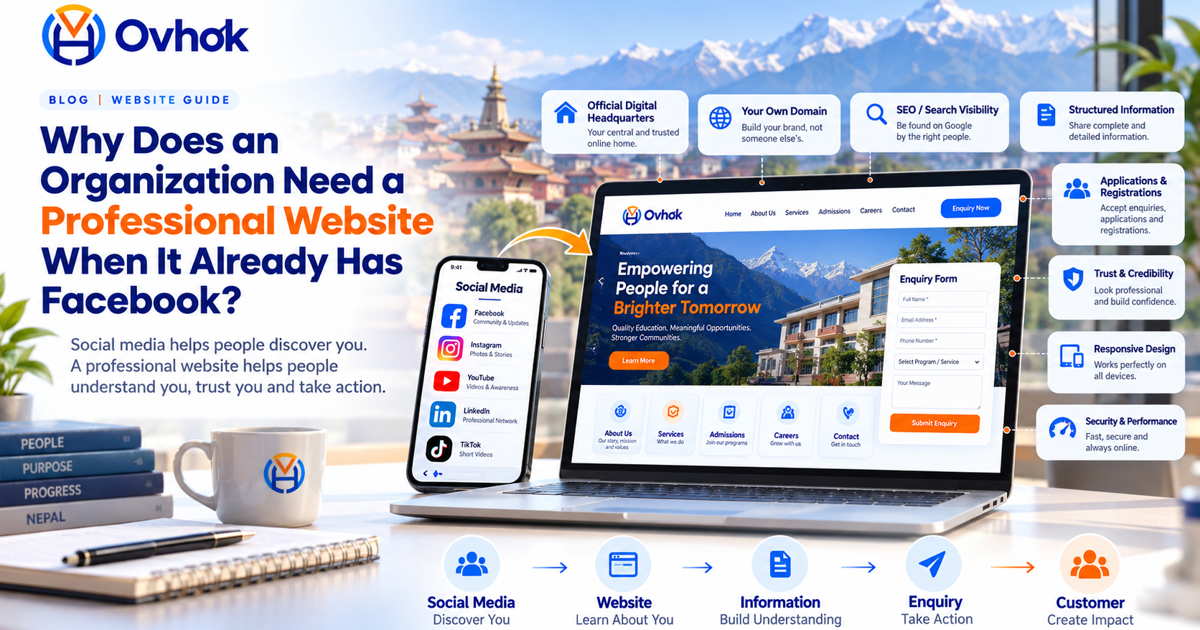
Why Does an Organization Need a Professional Website When It Already Has Facebook?
Facebook, Instagram, TikTok, YouTube, LinkedIn and other social platforms have changed the way organizations communicate with customers, students, parents, members, partners and the public.
They are fast, familiar and excellent for publishing updates, photos, videos, announcements and promotional content.
Because of this, many business owners and organization leaders ask:
"If our organization already has Facebook and social media pages, why should we invest in a professional website?"
The important point is that a website and social media are not substitutes for each other. They perform different jobs.
Social media helps people discover and interact with you. A professional website gives those people an official place to understand your organization, evaluate your credibility, explore your services and take meaningful action.
A strong digital organization therefore does not normally choose between a website and social media.
It uses both strategically.
Your Website Is Your Organization's Digital Headquarters
Think about your physical organization.
You may advertise through banners, newspapers, events, radio or other channels, but those advertisements are not your actual office.
Social media works similarly. It is an important communication and distribution channel, but it is not the complete digital identity of your organization.
Your website can become your official digital headquarters.
It can bring together:
- Your organization profile
- Products and services
- Leadership or management information
- Contact information
- Office location
- News and announcements
- Courses or programs
- Admission information
- Career opportunities
- Documents and downloads
- Enquiry forms
- Applications and registrations
- Customer support information
- Frequently asked questions
- Policies and legal information
Instead of asking visitors to search through hundreds of posts, you give them an organized place where important information is easy to find.
Professional Website vs. Facebook and Social Media
| Area | Professional Website | Facebook / Social Media |
|---|---|---|
| Main role | Official digital headquarters | Communication and audience engagement |
| Brand control | High control over design, structure and experience | Limited to platform layouts and features |
| Web address | Your own domain such as yourorganization.com | A profile inside another platform |
| Information structure | Permanent and organized pages | Primarily feed and timeline based |
| Search optimization | Individual pages can be optimized for relevant searches | Search presentation depends largely on the platform |
| Customer enquiries | Dedicated forms and conversion journeys | Messages, comments or platform-specific forms |
| Applications | Can support admissions, careers, bookings and registrations | Usually requires external tools or platform features |
| Custom functionality | Can integrate portals, APIs, payments and software systems | Limited to available platform capabilities |
| Content organization | Long-term structured information | Recent content usually receives most visibility |
| Analytics | Can measure website journeys and conversion goals | Analytics depend on what the platform provides |
| Platform dependency | Greater organizational control | Subject to platform policies and product changes |
1. A Professional Website Builds Credibility
When people hear about an unfamiliar organization, one of their first actions is often to search for it online.
Imagine a potential customer finds two businesses.
The first has only a social media profile.
The second has:
- A professional domain name
- A complete company profile
- Clear products and services
- Official contact information
- Office location
- Professional email addresses
- Customer enquiry options
- Policies and other supporting information
The second organization provides more information that a visitor can use to evaluate who it is and whether it appears legitimate and professional.
A website does not automatically create trust. The information still needs to be accurate, current and professionally presented.
However, a well-maintained official website can provide important trust signals that are difficult to communicate through a social feed alone.
2. Your Own Domain Strengthens Your Identity
Compare:
facebook.com/yourorganization
with:
www.yourorganization.com
or, where applicable:
www.yourinstitution.edu.np
Your own domain gives your organization a distinct web identity.
That same domain can also support branded email addresses such as:
This creates more consistent professional communication across your website, documents, proposals, business cards and email.
3. Your Website Organizes Information Properly
Social media is designed around feeds.
Suppose a school published an admission notice four months ago, followed by examination notices, photographs, videos, festival greetings, sports updates and other posts.
A parent visiting the page today may have difficulty locating the original admission information.
A website solves this by organizing information into logical permanent sections.
For example, a school website might include:
- About the School
- Admissions
- Academic Programs
- Facilities
- Notices
- News and Events
- Results
- Downloads
- Career Opportunities
- Contact Information
Visitors can go directly to the information they need.
4. Your Website Can Help People Find You Through Search
People do not discover organizations only through Facebook.
They also search using Google and other search services.
For example, someone might search for:
- Software company in Jhapa
- Website development company in Nepal
- School management software in Nepal
- Best school near Arjundhara
- Computer training institute in Birtamode
- Accounting software for Nepal
- Hotel in Jhapa
- Consultancy near me
With a professional website, different services and topics can have their own dedicated pages.
Those pages can use clear:
- Page titles
- Headings
- URLs
- Descriptions
- Relevant content
- Internal links
- Structured information
This gives search systems better information about your organization and the subjects your pages cover.
Social profiles may also appear in search results, but an organization has much greater control over the structure and content of its own website.
5. A Website Can Convert Interest Into Enquiries
Marketing is not only about attracting attention.
The next question is:
What should the visitor do after becoming interested?
A professional website can create clear conversion paths.
Depending on your organization, visitors may be able to:
- Request a quotation
- Request a callback
- Ask for a product demonstration
- Submit an enquiry
- Book an appointment
- Register for training
- Apply for admission
- Apply for a job
- Download a brochure
- View service packages
- Contact a specific department
These actions can be designed around the goals of the organization rather than around the features of a social platform.
6. Social Media Should Send Interested People to Your Website
Social media can become much more valuable when it works together with a website.
For example, instead of publishing every detail of a new service inside one Facebook post, an organization might publish:
"We have launched our new service. Learn about features, pricing and registration on our website."
The social post creates awareness.
The website provides complete information.
This creates a simple digital journey:
Social Media → Website → Information → Enquiry → Customer
For educational institutions:
Facebook Post → Admission Page → Application → Follow-up
For recruitment:
Social Job Post → Career Page → Job Details → Application
For training providers:
Social Promotion → Course Page → Course Details → Registration
7. You Should Not Depend Entirely on a Social Media Platform
Facebook, Instagram, TikTok, LinkedIn, YouTube and similar services are third-party platforms.
Their:
- Algorithms can change
- Policies can change
- Features can change
- Advertising systems can change
- Content formats can change
- Audience reach can change
These platforms remain useful and important, but an organization should avoid placing its entire digital presence in one external channel.
Your official website creates a stable central destination that can be promoted across all of your platforms.
8. A Website Supports Better Brand Presentation
Social-media pages use standardized platform layouts.
Your website can instead be designed around your organization's own:
- Brand colors
- Typography
- Photography
- Visual style
- Messaging
- Services
- Audience
- Business objectives
This gives businesses and institutions an opportunity to create a more distinctive digital identity.
9. A Website Can Improve Customer Service
Many organizations receive the same questions repeatedly.
Examples include:
- Where are you located?
- What services do you provide?
- What are your office hours?
- How can I apply?
- What documents are required?
- How can I contact support?
- Where can I download the form?
- How can I register?
A website can answer these common questions clearly.
This can make information more convenient for users and can reduce unnecessary repetitive communication for staff.
10. A Website Can Support Recruitment
Career opportunities often deserve more information than can comfortably fit inside a social post.
A dedicated career section can include:
- Available positions
- Job responsibilities
- Required qualifications
- Preferred skills
- Employment type
- Location
- Application deadline
- Application form
The organization can then share the career-page link through Facebook, LinkedIn and other channels.
Social media generates reach while the website manages the detailed job information and application journey.
11. Educational Institutions Benefit Especially From Professional Websites
Schools, colleges and training institutes communicate with many different groups:
- Students
- Parents
- Teachers
- Prospective students
- Government bodies
- Partners
- Former students
A professional educational website can provide structured information about:
- The institution
- Management
- Academic programs
- Admissions
- Facilities
- Notices
- Events
- Results
- Documents
- Contact information
Social media remains useful for photographs, celebrations, achievements and everyday updates, while the website remains the structured official information source.
12. A Website Can Support Sales and Business Development
For a business, a website can work as a digital sales assistant even when employees are unavailable.
A prospective customer can learn:
- What you provide
- Who your services are for
- How your solution works
- What problems you solve
- How to contact your team
- How to request a quotation
The website can also display:
- Case studies
- Frequently asked questions
- Customer testimonials
- Product information
- Service descriptions
- Demonstration requests
This allows potential clients to understand the organization before making direct contact.
13. Your Website Can Grow Into a Complete Digital Platform
A website may begin as a simple informational site.
As the organization grows, it can later connect with more advanced functionality.
Examples include:
- Customer portals
- Student portals
- Employee portals
- Online payments
- Booking systems
- Admission systems
- Course registration
- Customer relationship management systems
- Accounting software
- Billing systems
- Inventory management
- Help-desk systems
- APIs
- Third-party integrations
This is one major difference between a website and a social-media page.
A website can eventually become part of the organization's actual digital operations.
14. Websites Can Provide Better Measurement of Business Goals
A professional website can be configured to measure meaningful actions, subject to appropriate privacy and consent requirements.
Organizations may analyze:
- Which pages visitors view
- Which services attract interest
- How visitors arrive at the website
- Which enquiries are submitted
- Which campaigns send useful traffic
- Which pages need improvement
Instead of measuring only likes, views or followers, the organization can focus on outcomes that relate more closely to its goals.
These may include enquiries, applications, registrations, bookings or sales opportunities.
15. A Good Website Works Across Devices
Many visitors will open your website using a mobile phone.
A professional modern website should therefore be responsive and easy to use across:
- Mobile phones
- Tablets
- Laptops
- Desktop computers
Visitors should not need to zoom, struggle with tiny buttons or search through complicated navigation.
Mobile usability is not an optional extra. It is a fundamental part of a modern website.
16. Website Accessibility Matters
A professional website should be usable by as many people as reasonably possible, including people who use keyboards, screen readers or other assistive technologies.
Important considerations include:
- Clear headings
- Readable text
- Sufficient contrast
- Alternative text for meaningful images
- Keyboard-accessible controls
- Proper form labels
- Clear validation messages
- Logical navigation
Accessibility improves usability and creates a more inclusive digital experience.
17. Security Is Part of a Professional Website
A professional website should not be judged only by appearance.
It should also be designed with security in mind.
Important practices can include:
- HTTPS
- Secure administration
- Strong authentication
- Access control
- Safe form handling
- Input validation
- Secure file uploads
- Regular software updates
- Backups
- Monitoring and logging
A beautiful website that is insecure or unreliable is not a professional website.
18. Speed and Performance Affect User Experience
Visitors expect websites to respond quickly.
Large unoptimized images, excessive scripts, poor hosting or inefficient application design can make a website frustrating to use.
A professional website should therefore be designed with performance in mind through techniques such as:
- Optimized images
- Efficient page structure
- Appropriate caching
- Minimal unnecessary scripts
- Reliable hosting
- Performance monitoring
19. Your Website Can Become Your Official Source of Information
Organizations frequently publish information across Facebook, WhatsApp, email, printed notices and other channels.
This can occasionally create confusion when old posts continue circulating.
Your website can function as the central official reference.
For example:
"For the latest official admission information, visit ourschool.edu.np/admissions."
Social platforms can then distribute and amplify that official information.
20. A Website Helps People Who Do Not Use Facebook
Not everyone uses the same platform.
One customer may use Facebook.
Another may use LinkedIn.
A student may use Instagram.
A parent may simply use Google.
A corporate client may receive your website link through email.
Your website provides all of these audiences with one common destination.
Website and Social Media: The Best Strategy
The most effective question is therefore not:
"Should we have a website or Facebook?"
The better question is:
"How should our website and social media work together?"
A practical approach is:
- Create a professional official website.
- Organize your permanent information on the website.
- Create useful content for your audience.
- Share that content through social media.
- Link social posts back to relevant website pages.
- Make it easy for website visitors to contact or engage with you.
- Measure what generates useful enquiries and results.
- Continuously improve both your website and social-media strategy.
A Practical Example: School Admission
Imagine a school announces admissions.
On Facebook it publishes:
"Admissions Open for Academic Year 2083. Learn more and apply online."
The post links to:
schoolname.edu.np/admissions
The admission page contains:
- Available classes
- Eligibility
- Required documents
- Facilities
- Application process
- Important dates
- Frequently asked questions
- Contact details
- Online application form
Facebook creates awareness.
The website provides the complete journey.
A Practical Example: Business Service
Imagine a software company launches accounting software.
Its social-media post introduces the product with an attractive graphic or video.
The post then links to a dedicated product page containing:
- Product overview
- Features
- Who the product is designed for
- Frequently asked questions
- Screenshots or demonstration
- Contact information
- Request-a-demo form
Again:
Social media attracts attention.
The website turns attention into understanding and action.
What Should a Professional Organization Website Include?
Every organization has different requirements, but a strong professional website commonly includes:
- A clear homepage
- About Us
- Products or Services
- Contact information
- Location
- Clear calls to action
- Responsive mobile design
- Fast loading
- HTTPS security
- Search-friendly content
- Accessible navigation
- Privacy information
- Relevant legal or policy pages
Depending on the organization, it may also include:
- Blog or news
- Careers
- Courses
- Admissions
- Downloads
- Gallery
- Customer portal
- Online forms
- Bookings
- Payments
What Makes a Website Truly Professional?
Simply having a website is not enough.
A professional website should be:
- Useful: It answers the questions visitors actually have.
- Clear: Visitors can quickly understand the organization.
- Responsive: It works properly on mobile and desktop.
- Fast: Pages load efficiently.
- Secure: Appropriate security controls are applied.
- Accessible: It is designed for a broad range of users.
- Search-friendly: Pages clearly describe their topics.
- Maintainable: Information can be updated when it changes.
- Goal-oriented: It supports real organizational objectives.
Common Mistake: Creating a Website and Never Updating It
An outdated website can reduce confidence instead of increasing it.
Organizations should regularly review:
- Phone numbers
- Email addresses
- Staff information
- Services
- Prices where published
- Notices
- Career openings
- Policies
- Opening hours
Your website should represent the organization as it exists today.
Website vs. Facebook: Which Is More Important?
They solve different problems.
Facebook and other social platforms are excellent for:
- Community engagement
- Conversation
- Advertising
- Short-form content
- Photos and videos
- Announcements
- Building audience awareness
Your website is better suited to:
- Your official online identity
- Complete information
- Permanent structured pages
- Search-oriented content
- Applications
- Registrations
- Business enquiries
- Custom workflows
- Digital services
- Long-term organizational growth
This is why the strongest approach is:
Website + Facebook + Relevant Social Channels
rather than depending on only one platform.
Final Conclusion
A Facebook page is valuable, but it should not normally be the entire digital identity of a serious business, school, institute or organization.
Your website gives your organization a dedicated address on the internet, an organized source of information, greater control over presentation, opportunities for search visibility, structured enquiry journeys and the ability to introduce custom digital services over time.
Social media then becomes a powerful channel for distributing your message, growing your audience and bringing people back to that digital headquarters.
The relationship can be summarized simply:
Social media helps people discover you.
Your website helps people understand you.
Your content helps people trust you.
Your digital experience helps people take action.
Build a Professional Website for Your Organization
Ovhok Software Solutions Pvt. Ltd. develops professional websites and web-based software solutions for businesses, schools, educational institutions and other organizations.
Our approach focuses not only on appearance but also on practical business value, including responsive design, usability, accessibility, performance, search-friendly structure, security and maintainability.
Whether you need a simple professional organization website or a website connected with a larger business application, the solution should be designed around your actual workflow and audience.